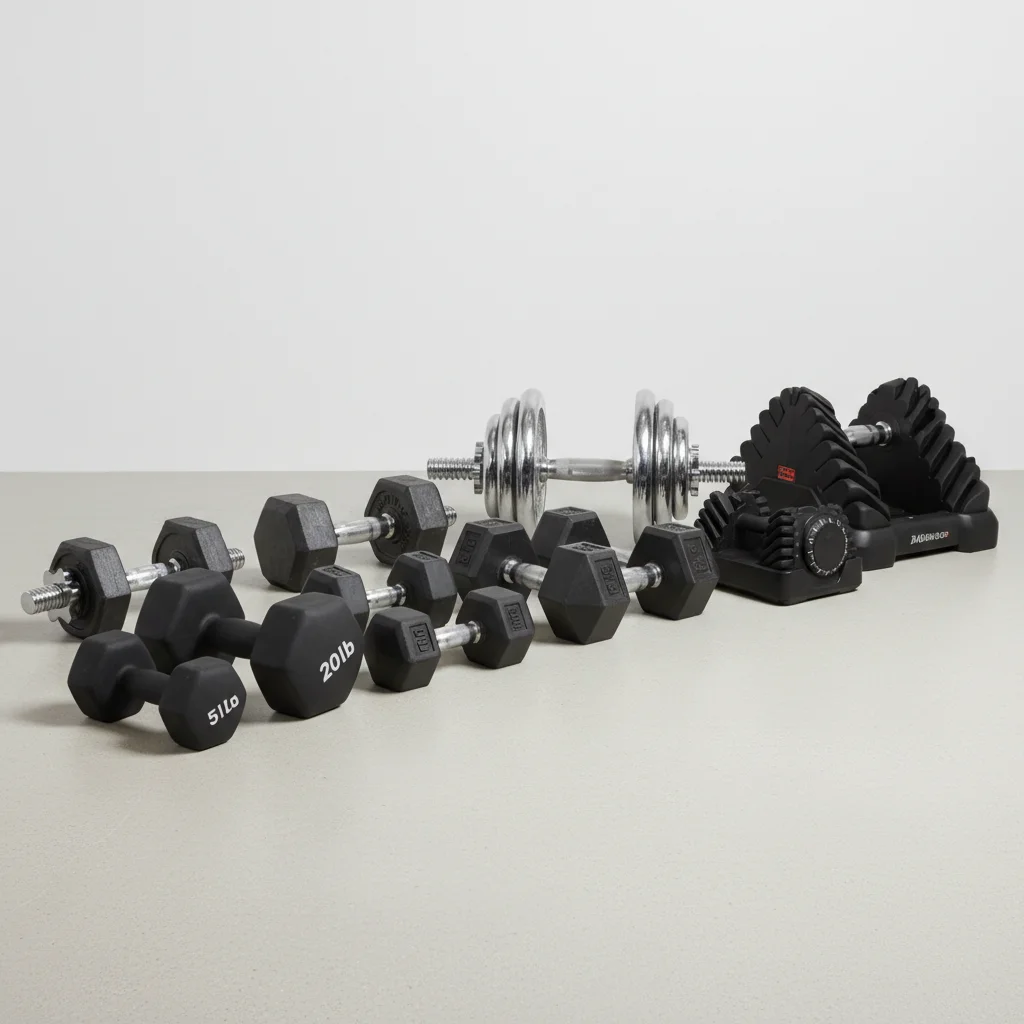
Choosing the right dumbbell set dimensions is crucial for effective and safe workouts, with the ideal size depending on your available space, lifting style, and specific exercise needs. For most home gyms, a compact set with a total footprint of no more than 3 square feet is recommended, while commercial gyms can accommodate larger, more varied dimensions.
Understanding Dumbbell Length and Diameter
Dumbbell length varies significantly, impacting how easily you can perform certain exercises. Standard fixed dumbbells typically range from 10 to 16 inches in length. Shorter dumbbells are ideal for exercises requiring close proximity to the body, such as bicep curls or triceps extensions, reducing the risk of hitting yourself or surrounding equipment. Longer dumbbells, often found in heavier weights, can be more challenging to maneuver in tight spaces but may offer a more balanced feel for some lifters. The diameter of the weight plates also plays a role; larger diameters can limit range of motion for certain movements, especially when lifting off the floor.
Plate Shape and Its Impact on Dimensions
The shape of your dumbbell plates directly influences the overall dimensions and storage requirements. Hexagonal dumbbells, for instance, prevent rolling and allow for easier stacking, making them a popular choice for home gyms with limited space. Their flat sides mean they can be placed on the floor without rolling away, which is a significant safety and convenience factor. Round dumbbells, while classic in appearance, require a rack with cradles to prevent rolling, adding to the overall footprint. Urethane-coated dumbbells often have a slightly larger diameter than their cast iron counterparts due to the protective coating, which should be considered when planning storage.
Adjustable Dumbbell Footprint Considerations
|
Our Picks for the Best Dumbbell Set in 2026
As an Amazon Associate I earn from qualifying purchases.
|
||
| Num | Product | Action |
|---|---|---|
| 1 | Amazon Basics Neoprene Dumbbell Hand Weights for Exercise and Muscle Toning |

|
| 2 | Adjustable dumbbell set,20/35/45/55/70/90lbs Free Weights set with upgraded nut, 5 in 1 Weight Set Used as Kettlebells, Barbell, Push up Stand, Fitness Exercise for Home Gym Suitable Men/Women |
|
| 3 | PowerBlock Elite EXP Adjustable Dumbbells, Sold in Pairs, Stage 1, 5-50 lb. Dumbbells, Durable Steel Build, Innovative Workout Equipment, All-in-One Dumbbells, Expandable with Expansion Kits |
|
| 4 | Adjustable Dumbbells Set of 2,Free Weights Dumbbells Set,Adjustable Dumbbell Set,52.5 lbs pair 105 lbs,15 in 1,for Men/Women Gym Equipment for Home Strength Training Equipment |
|
| 5 | Fitvids Set of 6 Neoprene Dumbbell Hand Weights, Set with Rack: 2/3/5 Pairs |
|
| 6 | CAP Barbell 150 LB Coated Hex Dumbbell Weight Set with Vertical Rack | Multiple Options |
|
| 7 | Amazon Basics Neoprene Dumbbell Hand Weights for Exercise and Muscle Toning |
|
| 8 | Adjustable Dumbbells, 20/30/45/70/90lbs Free Weight Set with Connector,5 in1 Dumbbells Set Used as Barbell,Kettlebells,Push up Stand,Fitness Exercises for Home Gym Suitable Men/Women |
|
| 9 | Adjustable Dumbbell Set, 20/33/45/70/90lbs Free Weight Set with Connector, 4 in1 Dumbbells Set Used as Barbell, Kettlebells, Push up Stand, Weight Set for Home Gym Suitable Men/Women |
|
| 10 | Amazon Basics Neoprene Dumbbell Hand Weights for Exercise and Muscle Toning |
|
Adjustable dumbbell sets offer a significant space-saving advantage over fixed sets, but their dimensions still vary. A typical adjustable dumbbell, such as a Bowflex SelectTech or Nuobell, might have a length of 15-18 inches and a width of 7-9 inches. While a single pair takes up minimal floor space, remember to account for the base or tray they sit in, which can add a few inches to the overall footprint. When selecting an adjustable set, consider not only the dimensions of the dumbbells themselves but also the space required to safely pick them up and put them down without obstruction.
Storage Solutions and Their Dimensional Needs
Effective storage is key to managing dumbbell set dimensions, especially in smaller environments. Vertical dumbbell racks are excellent for maximizing floor space, often holding multiple pairs within a footprint of less than 2 square feet. Horizontal racks, while requiring more linear space, can be easier to access for some users. Wall-mounted racks are another innovative solution for very tight spaces, keeping dumbbells off the floor entirely. Always measure your available space before purchasing a rack to ensure a proper fit and safe clearance for movement around it.
- Measure your workout area accurately before buying.
- Consider the length of dumbbells for exercises like rows and presses.
- Account for the base dimensions of adjustable dumbbell sets.
- Choose hexagonal plates for stability and easier floor storage.
- Factor in the space needed for a dedicated dumbbell rack.
Ergonomics and User Comfort
Beyond just fitting into your space, the dimensions of your dumbbells also affect ergonomics and user comfort. The handle length and diameter should be comfortable for your hand size, allowing for a secure grip without excessive strain. Too short a handle can lead to fingers being pinched, while too long a handle can feel unwieldy. The overall balance of the dumbbell, influenced by its dimensions and weight distribution, also plays a role in how natural and comfortable it feels during lifts. Always prioritize a set that feels good in your hands and allows for a full range of motion in your exercises.
Equipment that holds up past 60 sessions
Practical specs, not advice. Unsubscribe anytime.

This really helped me understand the difference in dumbbell length. I always just grabbed whatever was available, but realizing shorter dumbbells are better for exercises like triceps extensions makes so much sense. My old ones were always a bit awkward. I’m definitely going to invest in some shorter fixed dumbbells for those specific movements now.
As someone setting up a new home gym, the information on dumbbell set dimensions was exactly what I needed. I was about to buy a random set, but understanding how length impacts exercises like bicep curls and triceps extensions saved me from making a bad purchase. Now I know to look for specific lengths depending on the exercises I plan to do most often. Great guidance!
I was really struggling to figure out what size dumbbells would actually fit in my small apartment gym area. The advice about looking for a compact set with a total footprint of no more than 3 square feet was a game-changer. I ended up getting a great adjustable set that fits perfectly and I can finally do my bicep curls without bumping into everything. Super helpful!
I appreciated the breakdown of dumbbell length, especially for heavier weights. I found that the longer dumbbells, while sometimes harder to maneuver in my home gym, actually feel more balanced for my overhead presses. My only minor complaint is that it didn’t go into much detail about the different grip diameters, which can also make a big difference for comfort.